Food Choices - The Five Essential Elements to Consider
By June Pagan, Private Chef
1. Flavor: Everybody wants their food to taste good and be satisfying. This is the TRUE first consideration for food selection, because when we don’t enjoy the food we consume, we eventually will look elsewhere until we are able to find food choices that are satisfying. During hard times like these, food satisfaction becomes even more essential, as it is one of the most basic elements of our existence.
2. Health Value: This actually encompasses several areas that need to be considered, depending up the specific circumstances of each individual. Many of us are concerned about keeping our weight down, as excessive weight can lead to an array of medical problems. For others, of equal concern are specific elements of food choice. For example some of us must restrict salt intake, in order to maintain a healthy blood pressure level. Others must restrict sugar intake because of concern related to possible development of diabetes. Then there are those among us who have specific food allergies, such as being allergic to nuts, being lactose-intolerant, etc.
3. Cost: Food cost is a reality that must be taken into consideration by most of us. Only the extremely wealthy can ignore cost factors entirely. For the rest of us, it is a matter of degree. Since we are what we eat, most of us try to obtain the very best foods that we can, within the realm of what is financially possible. It is no secret that the cheaper food choices out there are more prone to being compromised by over-processing (you know this is an issue when most of the ingredients read like a chemistry lesson as opposed to actual foods).
4. Respecting Mother Nature by Obtaining Produce that is In Season: This is an element of food choice that many of us tend to overlook, because of the globalization changes that have taken place. For example, we can now find grapes year-round, even in the middle of winter! How is this possible? That’s an easy one – we bring them up from Chile, where it is like our summers even in the middle of February! What’s the problem with this? Well, we cannot be sure that other countries observe the same pesticide restrictions that are in place here in the United States. On the other hand, there are boutique-like farms around the world that strictly adhere to natural farming methods, operating sustainable farms (crop-rotation techniques, no use of pesticides, etc.). This means that the prudent chef must examine each source of produce on a case-by-case basis. There are no hard-and-fast rules with regard to consideration of selecting domestic versus imported of produce. Many of our farms in the United States may not be using DDT to protect their crops from insect invasion – but instead they use GMO techniques which are equally dangerous, and threaten to remove the nutritional value from our foods, as well as any flavor that might have been there. Those strawberries look delightful on the produce shelf at our local supermarket – AND they are farmed right here in California. Not so fast! Those strawberries may not have DDT on them, but they most certainly WILL have other pesticides that pose health risks, not to mention that they are very likely to have been developed using dangerous GMO techniques. Not surprisingly, I often discover that those beautiful strawberries have no flavor, even though they are so pretty in their luscious red coats.
5. Sustainability: Last but certainly not least, we need to consider sustainability. This means trying to purchase the majority of our produce from local purveyors, and making sure that those purveyors source their produce from farms that employ sustainable methods – such as crop rotation, responsible use of modern science (think “pluot” or nectarine). However, we cannot always adhere to purchasing our produce from local sources. There are a variety reasons for this. For example, during the cold season a few years back, we lost our entire crop of local oranges. So if a person wanted to enjoy a glass of fresh orange juice, they had to hope that the orange crop in Florida did not suffer the same fate. There are also farms in other countries that do use a sustainable approach, with the only drawback being that food is not from a local supplier. For example, the best vanilla beans available are from the Yucatan peninsula of our neighbor to the south (Mexico). Those beans are even better than the famous beans from Tahiti, which are no longer even available in the United States.
So how do these five elements relate to my work as a private chef? Here’s how: When I venture out in to the marketplace, I am confronted with a mind-boggling array of choices. I need to consider my client’s budget. I must strive to serve meals that satisfy the palate, while not being harmful to one’s health – for example avoiding dishes that clog up the arteries, elevate blood pressure, or unduly raise one’s blood sugar level. In many cases, the food selection process is limited by specific dietary restrictions, such as food allergies or specific medical conditions. For example, if I have a client who suffers from Meniere’s disease, I must be vigilant about not using any salt in their foods, and avoiding the use of any foods are naturally high in salt (such as soy sauce, for example). I must also strive to be socially responsible in my selection of food products. Failure to do so would be unethical on many levels. Just as I would not throw old engine oil into the trash can, I also must do my very best to avoid purchasing any food products that involve the use of earth-harming methods.
And speaking of health issues, another aspect comes to mind that is worth mention here: Kitchen Sanitation and food handling. As a personal chef, it is my duty to pay extra attention to how food is handled. It starts with staying informed. I receive daily notices from the FDA and other agencies, as well as various newsletters that discuss the current state of the food supply. I also attend the annual Natural Products Expo. This allows me to make informed food purchasing decisions.
As your private chef, I will be monitoring and rotating your food inventory, if you are in agreement. Very often we look at an expiration date on a product and think that it is okay to eat because it hasn’t expired. This is not always the case. The expiration date can be confusing...does it mean that the product has a long shelf life if unopened? What if the product has been opened (for example, vegetable oil or flour)? Did you know that garlic, when refrigerated, is more likely to develop mold? Another little-known fact is that containers of minced garlic can become contaminated with botulism if not refrigerated? I also use the highest quality water possible in my baking as well my cooking, as this improves the flavor and also results in a healthier meal.
Another consideration is the equipment that is used in the cooking process. In my kitchen, I use stainless steel All-Clad cookware. I do not use Teflon, because it tends to chip, and pieces the Teflon can contaminate the food. Yet another often overlooked aspect of food sanitation is the sponge – I routinely put my sponges in the microwave oven for sterilization and discard them at the end of the cooking session. The surface areas are washed down with an anti-bacterial and the floors are mopped and steam cleaned.
There is more than meets the eye at first glance, when it consumes to being a private chef. The selection of foods is at least as important as the technique of preparation. I must weigh each of the above five elements carefully, as I forage into the world of Farmer’s Markets, supermarkets, and specialty produce stores. I base many of my day-to-day menu decisions upon the availability of fresh, wholesome, and safe ingredients. After those criteria are met, I also try to purchase locally, while at the same time ensuring that the food source does not use farming techniques that are not sustainable. If the client is requesting a specific dish that would require the use of ingredients that do not measure up to the above described standards, I am sometimes able to employ carefully considered ingredient substitutes. When this is not possible, I will make suggestions of different dishes that are likely to satisfy the client without having a negative impact upon the health of those sitting at the dinner table. Each client requires a different mix of the above elements. Some of my clients have limited budgets. For those clients, I must consider cost first, and then do my best to create satisfying but healthful meals within their budgetary limitations. Some of my clients have specific health conditions. For those clients, I must design specific meals that confirm to mandatory dietary restrictions. Other clients have no serious threatening health issues, and have fairly deep pockets as well. For those clients, there is a larger focus on satisfying the palate and/or making elegant food presentations for their special guests.
The above described considerations are significant part of what you, the client, are paying for when you bring me aboard as your Private Chef. And these considerations take place before I ever step foot into your kitchen! Each consideration will have a certain weight (pardon the pun) to it, depending upon the specific needs of each individual. In designing a food program for my clients, I develop menu items based upon the individual needs. Think about your particular goals and any dietary restrictions. Consider the first three of the above five elements. (The fourth and fifth elements are important, but not a part of how you establish your priorities with the food program.) For example, here is what the percentages might look like for an individual with no dietary restrictions, a hefty budget, and a demanding palate:
Flavor: 70%
Health Value: 25%
Cost: 5%
Now here is an example of what the percentages would look like for a person with dietary restrictions, orders from the doctor to lose weight, and a limited budget:
Flavor: 20%
Health Value: 70%
Cost: 10%
And, take a look at what the percentages would be for a person with dietary restrictions, orders from the doctor to lose weight, but money is no object:
Flavor: 35%
Health Value: 60%
Cost: 5%
For folks with the above percentage ratio, the menu options are expanded, because the chef can spend more time procuring exotic items from a broad range of purveyors, selecting only the very finest of ingredients. However, for those with limited budgets, do not despair! A huge part of the benefit of working with an experienced private chef is that I have the experience and expertise that allows me to serve meals that are created from specially developed recipes that emphasize flavor while at the same time adhering to specific dietary restrictions.
Before we meet to discuss your specific situation, food preferences, dietary needs, and budget, consider the above elements of Food Choice. This will help us to create a customized approach to your food service that will best meet your needs.
Monday, February 15, 2010

Wednesday, November 4, 2009
How to eat like the Rich and Famous without Floating a Loan
I met a fellow chef, yesterday at the Interim Café (previous chef owner of Newsroom on Roberston) located on Wilshire at 6th Street inside the Verona building. What a cool place, very varied menu with spot on flavors. Reasonably priced. Take out type of atmosphere with small sit-down area inside and outside. Place is jammed but service is quick! Worth the wait and a lot better than the take out at Whole Foods, in my opinion.I also love the fact that I can always find 2 hour parking right there.
Anyway, my friend who is a fellow private chef gave me a tip on $9.99 a pound of Maine (actually Canadian) lobster, on sale at Santa Monica Seafood, a few blocks away on 10th Street at Wilshire. After lunch, I ran over there and grabbed two 1-1/2 lb live ones.
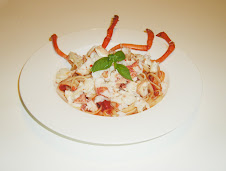
That evening, I prepared a toned down version of Lobster FraDiavolo with a high quality semolina linguini from Italy. Basically, I was able to put together a restaurant-quality meal for four of us, for less than $40. including the $7 pound of pasta.
2 Lobsters (3 lb total)
2 tbsp. Olive Oil
½ tsp. Chili Flakes (optional)
3 Cloves Garlic, minced
1 Shallot, minced
128 ounce can Muir Glen Crushed Tomatoes (or tomatoes of choice)
2 tbsp. Chiffonade of Basil
¾ lb. pasta cooked, al dente and drained
Place a stockpot with 2 inches of water on stove, salt (2 tsp) and cover; bring to a rapid boil. Quickly drop live lobsters into the pot and cover. Try to keep the boil high so that you don’t let the lobsters suffer more than they need to. Steam the lobsters for approximately 10-14 minutes. Remove and let cool. I save the shell and freeze it for future bisque use. Pull all of the meat out of the tail and claws, chop into bite-size chunks and combine with the juice from the shell. Meanwhile, get your sauce started - sauté garlic and chili peppers in olive oil until lightly browned, then add crushed tomatoes straight from the can. Season the sauce with a little salt and lower the flame to a simmer. After 10 minutes add the basil and continue cooking for another 10 minutes. Now toss the lobster and juice mix into the sauce in pan and heat through. Finally, toss the cooked pasta into the pan and swirl. It’s ready to serve.
We had the pasta dish with toasted Buona Forchetta baguette, rubbed with raw garlic and Vermont Creamery butter. This meal took ½ hour to prepare. Not a bad choice for a Tuesday night. Brought me back to my days of living in Maine.
Anyway, my friend who is a fellow private chef gave me a tip on $9.99 a pound of Maine (actually Canadian) lobster, on sale at Santa Monica Seafood, a few blocks away on 10th Street at Wilshire. After lunch, I ran over there and grabbed two 1-1/2 lb live ones.
That evening, I prepared a toned down version of Lobster FraDiavolo with a high quality semolina linguini from Italy. Basically, I was able to put together a restaurant-quality meal for four of us, for less than $40. including the $7 pound of pasta.
2 Lobsters (3 lb total)
2 tbsp. Olive Oil
½ tsp. Chili Flakes (optional)
3 Cloves Garlic, minced
1 Shallot, minced
128 ounce can Muir Glen Crushed Tomatoes (or tomatoes of choice)
2 tbsp. Chiffonade of Basil
¾ lb. pasta cooked, al dente and drained
Place a stockpot with 2 inches of water on stove, salt (2 tsp) and cover; bring to a rapid boil. Quickly drop live lobsters into the pot and cover. Try to keep the boil high so that you don’t let the lobsters suffer more than they need to. Steam the lobsters for approximately 10-14 minutes. Remove and let cool. I save the shell and freeze it for future bisque use. Pull all of the meat out of the tail and claws, chop into bite-size chunks and combine with the juice from the shell. Meanwhile, get your sauce started - sauté garlic and chili peppers in olive oil until lightly browned, then add crushed tomatoes straight from the can. Season the sauce with a little salt and lower the flame to a simmer. After 10 minutes add the basil and continue cooking for another 10 minutes. Now toss the lobster and juice mix into the sauce in pan and heat through. Finally, toss the cooked pasta into the pan and swirl. It’s ready to serve.
We had the pasta dish with toasted Buona Forchetta baguette, rubbed with raw garlic and Vermont Creamery butter. This meal took ½ hour to prepare. Not a bad choice for a Tuesday night. Brought me back to my days of living in Maine.
Friday, October 23, 2009
Private Chef Workshops
Tricks of the Private Chef Trade
Workshop by June Pagan, Private Chef
Workshop #1 “Cooking Your Way to Job Security”
Small Class Size (6-8 students, face-to-face approach)
8 Hour course (one day)
Price: $175.00
Hours: 10AM- 6PM
Dates: To be arranged - call or email for current information
Location: Marina Del Rey, CA 90292
Instructor: June Pagan, Los Angeles private chef since 1985
http://www.junepagan.com/
310.823.0929 office
310.832.0509 cell
e-mail:junepagan@verizon.net
The purpose of this workshop is to teach the student how to deliver simple, healthy and flavorful meals to their family or employer’s family.
We start the morning with a trip to Gelson’s Market, where I will guide you through the aisles and provide you with shopping tips and invaluable information about product selection.
Upon our return to the kitchen, the face-to-face demonstration cooking will begin, starting with breakfast-type breads and a discussion about the morning meal, including a hands-on preparation of the most intimidating “poached egg.”
As we move on to lunch options, there will be an in-depth discussion about the role of the private chef with abundant tips for effective work habits, such as CAYG (Clean As You Go), When In Doubt (Throw It Out), and “Garnish ,Garnish, Garnish” (presentation). We will also touch briefly on Front Service (dining room skills and strategies).
By dinner, we will be focusing on the details that make a meal “Top Notch,” Our clients are refined and have discriminating palates. They demand well-prepared meals that are a joy to consume. By providing this service to them you are building “Job Security”
Here are some sample recipes that we will be offering:
· Roast Salmon Croquettes “Old Bay” with a variety of sauces
· Asian Inspired Piedmontese New York Steak, Pan Grilled
· Oven Rotisserie Chicken with Apricot “Saucy Susan” Sauce
· Thanksgiving Turkey Burger
· Grilled Miso Shallot Chicken Salad
· Whole Wheat Walnut Bread
· The perfect Apple Pie
· She Devil Mocha Flourless Cake
Included with this workshop will be recipes of all dishes prepared and a list of recommended reading, as well as resources for product used in the workshop.
For a successful learning experience, be sure to have a pen and a notepad, and good night’s sleep. It will be intense!
Thank you,
June Pagan
Workshop by June Pagan, Private Chef
Workshop #1 “Cooking Your Way to Job Security”
Small Class Size (6-8 students, face-to-face approach)
8 Hour course (one day)
Price: $175.00
Hours: 10AM- 6PM
Dates: To be arranged - call or email for current information
Location: Marina Del Rey, CA 90292
Instructor: June Pagan, Los Angeles private chef since 1985
http://www.junepagan.com/
310.823.0929 office
310.832.0509 cell
e-mail:junepagan@verizon.net
The purpose of this workshop is to teach the student how to deliver simple, healthy and flavorful meals to their family or employer’s family.
We start the morning with a trip to Gelson’s Market, where I will guide you through the aisles and provide you with shopping tips and invaluable information about product selection.
Upon our return to the kitchen, the face-to-face demonstration cooking will begin, starting with breakfast-type breads and a discussion about the morning meal, including a hands-on preparation of the most intimidating “poached egg.”
As we move on to lunch options, there will be an in-depth discussion about the role of the private chef with abundant tips for effective work habits, such as CAYG (Clean As You Go), When In Doubt (Throw It Out), and “Garnish ,Garnish, Garnish” (presentation). We will also touch briefly on Front Service (dining room skills and strategies).
By dinner, we will be focusing on the details that make a meal “Top Notch,” Our clients are refined and have discriminating palates. They demand well-prepared meals that are a joy to consume. By providing this service to them you are building “Job Security”
Here are some sample recipes that we will be offering:
· Roast Salmon Croquettes “Old Bay” with a variety of sauces
· Asian Inspired Piedmontese New York Steak, Pan Grilled
· Oven Rotisserie Chicken with Apricot “Saucy Susan” Sauce
· Thanksgiving Turkey Burger
· Grilled Miso Shallot Chicken Salad
· Whole Wheat Walnut Bread
· The perfect Apple Pie
· She Devil Mocha Flourless Cake
Included with this workshop will be recipes of all dishes prepared and a list of recommended reading, as well as resources for product used in the workshop.
For a successful learning experience, be sure to have a pen and a notepad, and good night’s sleep. It will be intense!
Thank you,
June Pagan
Sunday, October 11, 2009
Who Can Afford to Go Organic
Lets, face it, most of us cannot afford to provide organic foods to our families, even if we decide to adopt a Vegan lifestyle and eat only, vegetables, fruits nuts and seeds. I am managing to do so for my family but I am a professional cook with thirty five years of knowledge in the field of health cooking and I know my way around town. On any given day I waste gallons of gas picking up “clean food” at the various markets that I frequent. The cost of providing these foods has nearly tripled our budget and shopping time.
Take a typical single low income (and the number is rising) parent in Los Angeles, generally a mother. She gets her children off to school long before the morning bell rings so that they can have a subsidized breakfast of GMO grain sweetened cereal, milk(I don’t even want to go there), and perhaps a piece of fruit which they will probably toss out. After the mother lovingly and painfully drops her kids off to breakfast and a day at school she scurries off to her job, perhaps at a Beverly Hills home where she is a housekeeper making a damn good wage of $15 per hour with out benefits, since the employer has her working only part time, four twelve hour days instead of five eight hour days. Of course she volunteered to do this so that she could have three days with her children; only the employer wants her to work weekends. She dare not refuse him.
If she earns enough money to own a car, pay insurance and maintenance, and has a place to park off the street, she is lucky, which is generally not the case. Keeping a car in Los Angeles is hard for the single parent but an absolute necessity. Somehow, she manages to get to her job and she puts in a hard day while her children attend school and then the afternoon Star Program which basically baby sits the children until mom can pick them up .It’s always frantic at this point because it is “rush hour”
So now mom has her kids safely with her and they need to rush home to finish homework, have dinner and get ready for the next day. Hopefully they are well and no one is sick with the flu, or any other child hood ailment that needs medical attention. Now mom has to think about preparing dinner, do you think that she is thinking about buying organics? She goes to the closest market to her home and buys the least expensive foods or the most convenient foods. She is not concerned and cannot afford to be concerned about the quality of the food her family is consuming, she relies on the FDA to keep them from the doctors office .She does not recognize the difference between a sixteen dollar free range chicken and a four dollar toxic bird. She says to herself “I wish that I could feed my children the way my employer feeds his. Tonight he is feeding his kids Vintage New York Steak on the grill with organic russet potatoes topped with organic sour cream from a creamery in Sonoma and locally grown asparagus ,because his wife is asking him to go “green.”
So now mom has to shop and prepare dinner for her children. Tonight they are having Hamburger Helper made with two dollar chuck, perhaps she will throw in a little frozen broccoli which she picks up on sale for less than a dollar because she heard somewhere that cruciferous vegetables were healthy for you. In addition to that she buys a corn-laden GMO and enough MSG to flavor a piece of cardboard dessert of pretty little animal shaped cookies for the kids. They will wash it down with a corn sweetened imitation juice.
I am standing in line behind her and watching and my heart is bleeding. I have just come from my job as a private chef. Tonight I made Vintage New York Steak on the grill with organic russet potatoes topped with organic sour cream from a creamery in Sonoma and locally grown asparagus because his wife is asking him to go “green.”
Take a typical single low income (and the number is rising) parent in Los Angeles, generally a mother. She gets her children off to school long before the morning bell rings so that they can have a subsidized breakfast of GMO grain sweetened cereal, milk(I don’t even want to go there), and perhaps a piece of fruit which they will probably toss out. After the mother lovingly and painfully drops her kids off to breakfast and a day at school she scurries off to her job, perhaps at a Beverly Hills home where she is a housekeeper making a damn good wage of $15 per hour with out benefits, since the employer has her working only part time, four twelve hour days instead of five eight hour days. Of course she volunteered to do this so that she could have three days with her children; only the employer wants her to work weekends. She dare not refuse him.
If she earns enough money to own a car, pay insurance and maintenance, and has a place to park off the street, she is lucky, which is generally not the case. Keeping a car in Los Angeles is hard for the single parent but an absolute necessity. Somehow, she manages to get to her job and she puts in a hard day while her children attend school and then the afternoon Star Program which basically baby sits the children until mom can pick them up .It’s always frantic at this point because it is “rush hour”
So now mom has her kids safely with her and they need to rush home to finish homework, have dinner and get ready for the next day. Hopefully they are well and no one is sick with the flu, or any other child hood ailment that needs medical attention. Now mom has to think about preparing dinner, do you think that she is thinking about buying organics? She goes to the closest market to her home and buys the least expensive foods or the most convenient foods. She is not concerned and cannot afford to be concerned about the quality of the food her family is consuming, she relies on the FDA to keep them from the doctors office .She does not recognize the difference between a sixteen dollar free range chicken and a four dollar toxic bird. She says to herself “I wish that I could feed my children the way my employer feeds his. Tonight he is feeding his kids Vintage New York Steak on the grill with organic russet potatoes topped with organic sour cream from a creamery in Sonoma and locally grown asparagus ,because his wife is asking him to go “green.”
So now mom has to shop and prepare dinner for her children. Tonight they are having Hamburger Helper made with two dollar chuck, perhaps she will throw in a little frozen broccoli which she picks up on sale for less than a dollar because she heard somewhere that cruciferous vegetables were healthy for you. In addition to that she buys a corn-laden GMO and enough MSG to flavor a piece of cardboard dessert of pretty little animal shaped cookies for the kids. They will wash it down with a corn sweetened imitation juice.
I am standing in line behind her and watching and my heart is bleeding. I have just come from my job as a private chef. Tonight I made Vintage New York Steak on the grill with organic russet potatoes topped with organic sour cream from a creamery in Sonoma and locally grown asparagus because his wife is asking him to go “green.”
Thursday, August 13, 2009
What’s all the buzz about Quinoa?
I have to admit that I wasn’t all that impressed by the flavor or texture of quinoa when I first tasted it. Then I did some research about the grain and discovered that it had many healthy attributes that go far beyond the flavor. I found out that:
Quinoa is in the fruit family and is very easy to digest.
The nutritional properties in quinoa are very similar to mother’s milk (great for Vegans and non-dairy consumers)
1 Cup of cooked Quinoa has as much calcium as a quart of milk
Quinoa is rich in folate
It is 60% higher in protein than wheat, barley, corn and rice
The protein in quinoa has all of the Essential Amino Acids present
Quinoa is high in lysine which is rare in the plant kingdom
It is low in gluten, great for gluten free baking but does not really work that well for bread, from my experience
Quinoa is a high fiber slow release carbohydrate which is good for diabetics
It is an alkaline grain compared to other grains that are considered acidic
Quinoa is rich in magnesium, manganese, and copper, elements that combat stress, relaxes blood vessels, great for migraines and the heart.
Quinoa is rich in lignans, which may be a protector against hormone related cancers, such as breast cancer.
The highest quality quinoa comes from Bolivia and Peru.
Altiplano is the sweet delicate ivory colored variety that grows 12,500 feet above sea level.
Quinoa is in the fruit family and is very easy to digest.
The nutritional properties in quinoa are very similar to mother’s milk (great for Vegans and non-dairy consumers)
1 Cup of cooked Quinoa has as much calcium as a quart of milk
Quinoa is rich in folate
It is 60% higher in protein than wheat, barley, corn and rice
The protein in quinoa has all of the Essential Amino Acids present
Quinoa is high in lysine which is rare in the plant kingdom
It is low in gluten, great for gluten free baking but does not really work that well for bread, from my experience
Quinoa is a high fiber slow release carbohydrate which is good for diabetics
It is an alkaline grain compared to other grains that are considered acidic
Quinoa is rich in magnesium, manganese, and copper, elements that combat stress, relaxes blood vessels, great for migraines and the heart.
Quinoa is rich in lignans, which may be a protector against hormone related cancers, such as breast cancer.
The highest quality quinoa comes from Bolivia and Peru.
Altiplano is the sweet delicate ivory colored variety that grows 12,500 feet above sea level.
The Valley variety grows at 70,000 to 10,000 feet above sea level and is very common in Peru.
Not as common, is the Chenopodium Quinoa which is a rare organic quinoa grown on small family owned plots at over 12,000 feet in the Andean Plateu in Bolivia.
Friday, July 24, 2009
Yes We Can!
Pay it Forward
By going to www.vanilla.com, the go to resource for all tropical products, weekly recipes, tips, and a blog section titled “Yes We Can” about socially conscious projects in developing countries, a section for farmers, book reviews, info and articles about all tropical commodities and how to use them (especially tea, chocolate, coffee and vanilla)
The goal of the creator, Patricia Rain aka the Vanilla Queen is for people on developed countries to have a better understanding of the political, social, and environmental issues of the tropics and why WE MUST support those who live there and grow the crops WE LOVE!
If the tropics go, our planet goes.
For socially conscious companies interested in advertising on their site or to purchase premium quality vanilla at a great price, go to www.vanilla.com. Or call Gina at 800.757.7511. Shipments are on Tuesday.
By going to www.vanilla.com, the go to resource for all tropical products, weekly recipes, tips, and a blog section titled “Yes We Can” about socially conscious projects in developing countries, a section for farmers, book reviews, info and articles about all tropical commodities and how to use them (especially tea, chocolate, coffee and vanilla)
The goal of the creator, Patricia Rain aka the Vanilla Queen is for people on developed countries to have a better understanding of the political, social, and environmental issues of the tropics and why WE MUST support those who live there and grow the crops WE LOVE!
If the tropics go, our planet goes.
For socially conscious companies interested in advertising on their site or to purchase premium quality vanilla at a great price, go to www.vanilla.com. Or call Gina at 800.757.7511. Shipments are on Tuesday.
Subscribe to:
Posts (Atom)